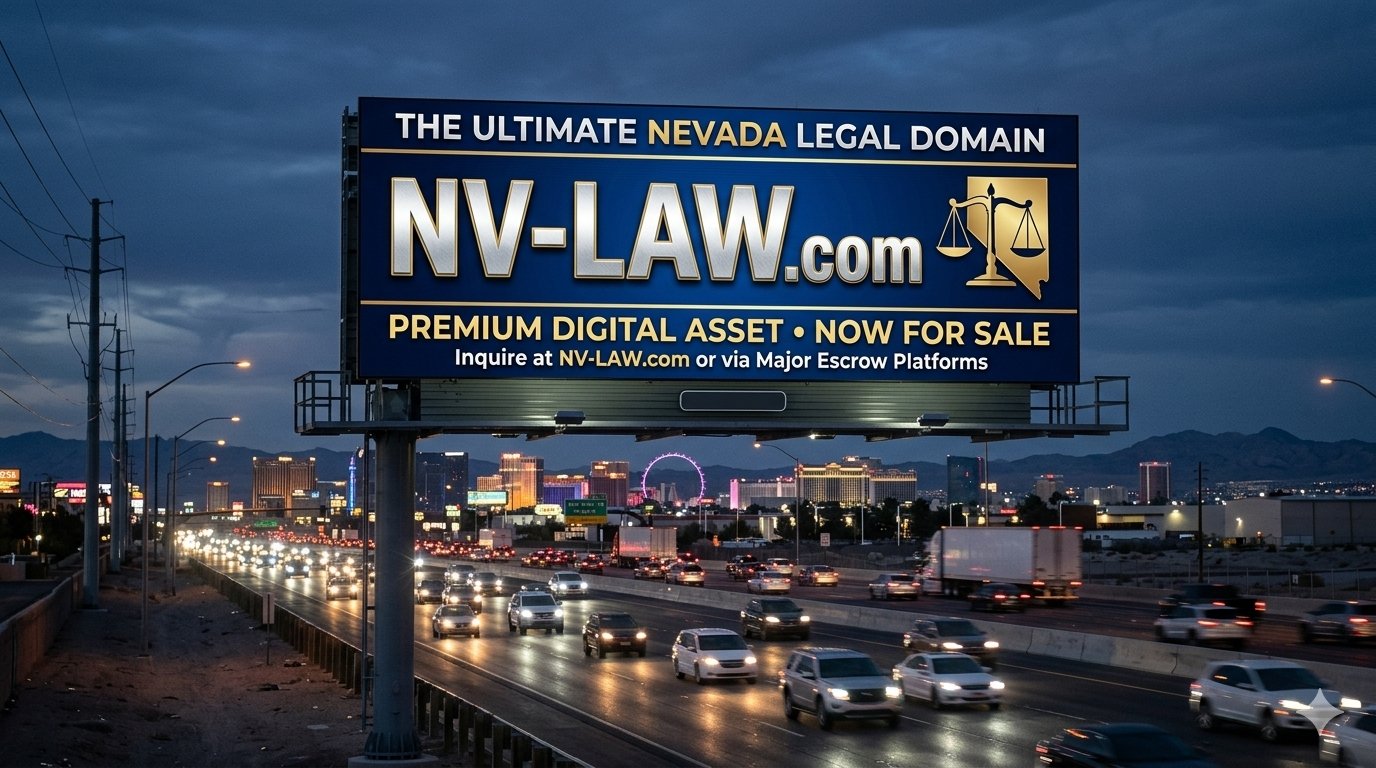

The acquisition of a category-defining digital asset represents a singular opportunity for forward-thinking legal operations seeking absolute market authority.
Within the contemporary digital ecosystem, premium domain names operate as the absolute bedrock of modern brand architecture, profoundly influencing client acquisition channels, long-term search engine visibility rankings, and institutional trust dynamics across the entire legal sector.
The domain nv-law.com stands as a premier example of high-value digital real estate, specifically engineered to command the rapidly expanding Nevada legal marketplace.
As regional commerce accelerates across Las Vegas, Reno, Sparks, Carson City, and Henderson, securing an intuitive, highly authoritative web presence is no longer an optional marketing strategy but an absolute operational necessity for top-tier law firms looking to maintain their market dominance.
For established legal practices and rapidly scaling firms alike, the transition to an exact-match geographic domain yields immediate competitive advantages over legacy multi-word web structures.
A premium digital address strips away the structural friction inherent in traditional digital branding, replacing long, easily forgotten web links with an unforgettable digital gateway.
When a prospective corporate client, small business owner, or injured individual requires immediate legal counsel, cognitive retention dictates that they turn to the most direct, trustworthy, and authoritative brand available in their jurisdiction.
Operating under a highly focused domain minimizes marketing waste across television, radio, print, digital media, and physical highway billboards, ensuring that every single advertising dollar spent drives traffic to an unmistakable digital destination.
Beyond the clear advantages of immediate brand recognition and offline marketing efficiency, exact-match digital assets provide unparalleled leverage within complex digital discovery algorithms.
Modern search engines heavily prioritize relevance, regional authority, and historical trust signals when determining top positions for hyper-competitive legal search terms.
Owning an authoritative platform built on an exact-match keyword combination dramatically accelerates organic search engine placement, enabling a firm to bypass years of aggressive search engine optimization spending and costly advertising overhead.
By capturing highly valuable organic search traffic, the rightful owner of this digital storefront can consistently outpace regional competitors in high-stakes fields like corporate litigation, personal injury, mass torts, gaming law, family law, and estate planning.
The strategic acquisition of premium digital assets is increasingly recognized as a foundational corporate investment strategy for top-performing legal teams globally.
Modern digital real estate behaves much like prime physical real estate, appreciating consistently over time due to the finite nature of high-quality dot-com profiles.
A firm operating on an inferior sub-domain or a convoluted alternative extension routinely cedes valuable ground to competitors willing to secure primary market markers.
Investing in an elite digital hub blocks rival firms from capitalizing on market confusion while establishing an unassailable digital fortress that communicates prestige, financial strength, and market dominance to consumers and corporate entities alike.
In addition to serving as a primary corporate brand identity, this unique digital property holds immense value as a dedicated, high-converting lead generation hub.
Large regional law groups frequently maintain multiple web properties to capture disparate segments of the consumer marketplace without diluting their core institutional brand name.
By positioning an independent portal on this premium domain, a practice can capture distinct market segments, run highly targeted localized landing pages, and aggregate high-intent consumer case requests at a fraction of standard pay-per-click acquisition costs.
This multi-layered digital architecture maximizes statewide market share while building an independent, appreciating corporate asset that can be leveraged, scaled, or sold in the future.
The history of premium digital transactions clearly demonstrates that elite legal domains consistently command top valuation premiums due to the extraordinarily high lifetime value of legal clients.
A single high-value corporate dispute, commercial real estate conflict, or catastrophic injury settlement acquired through an authoritative digital channel can completely offset the initial capital expenditure of the domain purchase.
As the modern legal marketplace becomes increasingly saturated with aggressive advertising campaigns, standard promotional avenues suffer from severe diminishing returns.
Digital assets, conversely, offer a permanent, non-expiring infrastructure that insulates a firm from fluctuating advertising platform algorithms and rising keyword auction costs.
Prospective buyers are invited to review the comprehensive technical specifications, clean backlink profile, and structural advantages inherent in this exceptional branding opportunity.
The asset is fully prepared for an immediate, seamless title transfer via verified institutional escrow frameworks to guarantee complete transactional protection for both parties involved.
As part of a corporate asset restructuring initiative, this premium asset is being presented exclusively to qualified firms, legal networks, and forward-thinking investors seeking an immediate market expansion platform.
Interested parties are encouraged to initiate preliminary discussions to secure this definitive regional digital identity before its formal submission to public digital asset auctions.
This premium asset offering is managed exclusively by the professional digital brokerage team at ADvertibles.
Parties wishing to submit a formal acquisition proposal or arrange a confidential consultation regarding transactional structures are directed to reach out through established communication channels.
Initial inquiries and purchase bids may be directed to our primary electronic intake system at 1@advertibles.com.
com for accelerated evaluation by our asset management team.
Alternatively, interested organizations can track asset updates, view upcoming digital inventory portfolios, and initiate secure direct messaging via our verified social platform communications interface located at x.
com/advertibles.
All expressions of interest will be handled with strict confidentiality.
Exclusive Corporate Acquisition IntakeThis premium asset domain is curated exclusively by ADvertibles.
Secure escrow settlement protocols apply to all incoming acquisition transactions.
Email: 1@advertibles.com.
comX Platform: @advertibles© 2026 ADvertibles Asset Management.
All rights reserved.
Asset Class: Premium Digital Real Estate.
Why Nevada Law is Unlike Anywhere Else on Earth
When people think of Nevada, images usually flash to neon-lit casino floors, vast stretches of lonely desert highway, quick-fix wedding chapels, and the neon pulse of the Las Vegas Strip. But beneath the pop-culture exterior lies one of the most dynamic, idiosyncratic, and business-shaping legal ecosystems in the United States.
Nevada is a jurisdiction built on a frontier spirit. It is a state where rugged individualism collided head-on with an early economic need to reinvent itself—giving birth to a legal framework that treats freedom, commerce, and personal autonomy quite differently than its sister states.
If you are looking at the Silver State through a purely textbook lens, you are missing the point. Nevada law is fascinating because it is perpetually caught in a high-stakes tug-of-war between its wild-west heritage and its status as a modern corporate titan.
The Ultimate Legal Paradox: Wild West Roots Meets Corporate Powerhouse
On one hand, Nevada remains fiercely protective of its eccentric, frontier-era DNA. This is a place where you can still legally run a red light if you are leading a funeral procession (Nevada is famously the only state where this specific traffic rule is codified), where open-range laws mean a rancher generally bears no fault if your car totals itself against a stray 1,200-pound steer, and where local ordinances have historically banned everything from hula-hooping larger than four feet on Fremont Street to placing a stray chair on a Reno sidewalk without express city council sign-off.
On the other hand, corporate boardrooms across America bow to Nevada jurisprudence.
Long before Delaware became the default home for corporate charters, Nevada engineered a corporate code that shields directors and officers with some of the most robust liability protections in the world. It built a legal sandbox that attracts Fortune 500 companies, asset protection trusts, and high-net-worth individuals seeking absolute privacy and ironclad asset defense.
Why the Nevada Legal Market Captivates
What makes Nevada law endlessly compelling is that it refuses to be boring. It sits at the intersection of stark contrasts:
- The Sovereign Sandbox: From pioneering legalized gaming and rapid-divorce laws in the early 20th century to modern frameworks for blockchain sandboxes and autonomous vehicle testing, Nevada has historically used legislation as a marketing tool to draw economic pioneers across its borders.
- The Trust & Privacy Fortress: Nevada consistently ranks at the top for estate planning and asset protection. Its laws regarding perpetual trusts and shield-like corporate veils make it a domestic tax and liability haven.
- The Everyday Surprises: Even outside the boardroom, local Nevada municipal codes and state statutes present a dizzying array of quirks—like the statutory ban on pawning your own prescription dentures in Las Vegas, or the strict rules governing mining-stock rumors leftover from the Comstock Lode era.
What Lies Ahead in This Guide
In the subsequent sections of this overview, we will peel back the layers of what makes practicing, operating, or simply living under Nevada law entirely unique. Whether you are evaluating this digital asset for acquisition, looking to understand corporate structuring in the Silver State, or simply curious about how a desert economy built an empire of law, the chapters ahead map out the terrain.
The Corporate Fortress: Why Nevada Conquered the Boardroom
If the first defining feature of Nevada law is its wild-west eccentricity, the second is its absolute dominance as a corporate and financial fortress. Long before startup founders and multinational conglomerates look anywhere else, they look to Carson City.
Nevada did not win the corporate migration game by accident. It engineered a legal product specifically designed to outcompete traditional east-coast jurisdictions, crafting an environment where directors, officers, and asset-holders operate behind some of the thickest statutory shields in the Western Hemisphere.
The Shield: Corporate Veil Protection and Director Liability
At the heart of Nevada’s corporate appeal is how the state treats personal liability. In many jurisdictions, piercing the corporate veil—holding owners or directors personally responsible for company debts or legal judgments—is a constant, looming threat.
Nevada law takes the opposite approach. The state legislature deliberately codified exceptionally high legal bars for piercing the corporate veil. Under Nevada Revised Statutes (NRS Chapter 78), a plaintiff must clear monumental hurdles to prove that a corporation was merely the alter ego of its owner.
Furthermore, Nevada statutory law protects directors and officers with broad indemnification and immunity provisions. Directors are generally presumed to have acted in good faith, placing an immense burden of proof on anyone attempting to sue management over business decisions. For entrepreneurs and executives who want to innovate without constantly looking over their shoulders at potential litigation, Nevada offers a profound sense of operational security.
Asset Protection Trusts: The Ironclad Vault
Beyond corporations, Nevada has quietly become the premier domestic jurisdiction for asset protection trusts (APTs).
For decades, if individuals wanted to shield generational wealth from future creditors, divorcing spouses, or aggressive lawsuits, they often looked offshore to opaque foreign accounts in the Cook Islands or Switzerland. Nevada changed the domestic landscape by introducing laws that allow self-settled spendthrift trusts.
Under Nevada trust law:
- Shorter Statute of Limitations: Creditors have a drastically limited window—often just two years from the transfer date, or six months if they discovered the transfer later—to challenge assets placed into an APT.
- No Exception Creditors: Unlike many states that carve out loopholes for alimony, child support, or tort victims to pierce domestic trusts, Nevada's statutes provide exceptionally rigid barriers against outside claims.
- Perpetual Lifespan: Nevada abolished the traditional rule against perpetuities, allowing trusts to endure indefinitely across generations without incurring forced liquidations or tax restart penalties.
The Privacy Advantage
In an era where digital exposure is a constant operational hazard, privacy is a valuable commodity. Nevada corporate filings allow business owners to maintain a high degree of personal anonymity. Directors and shareholders are frequently not required to be listed on public-facing articles of incorporation, shielding private individuals from targeted harassment, predatory litigation, or unwanted public scrutiny.
Scales in the Desert: The Judicial Evolution and Business Courts of Nevada
A robust corporate code is only as powerful as the courts that interpret it. Recognizing that a dynamic commercial hub requires swift, predictable, and highly specialized judicial oversight, Nevada systematically modernized its legal machinery.
The state transformed its judiciary from a sparse, frontier-era dispute mechanism into one of the most sophisticated, business-friendly court architectures in the United States.
From Comstock Looms to the High Bench: A Unique Judicial Heritage
Nevada’s judicial history is anchored in its explosive birth during the Civil War. Admitted to the Union in 1864 primarily to shore up Lincoln's congressional majority and secure the mineral wealth of the Comstock Lode, the state inherited a legal landscape driven by mining disputes, water rights, and fierce territorial competition.
Early Nevada judges did not have the luxury of slow, academic jurisprudence. They adjudicated complex property lines, underground mineral extractions, and multi-party resource conflicts on the fly, establishing a pragmatic tradition of judicial problem-solving.
At the apex of this system sits the Nevada Supreme Court. Operating under a structure where justices frequently rotate and hear cases en banc or in panels, the court has long earned a reputation for business-forward pragmatism. Rather than relying solely on rigid adherence to archaic common-law traditions, Nevada's high court has consistently demonstrated a willingness to interpret statutes in ways that protect commercial stability, party expectations, and contractual freedom.
The Crown Jewel: Nevada’s Specialized Business Courts
The single most consequential structural evolution in modern Nevada law occurred in the late 1990s and early 2000s: the establishment of dedicated Business Courts within the state's judicial districts (most notably in Clark and Washoe counties).
Recognizing that complex corporate, securities, and commercial litigation requires deep expertise rather than general docket rotation, Nevada carved out specialized business dockets. These courts handle complex corporate governance disputes, shareholder derivative actions, commercial contract breakdowns, and intellectual property litigation.
Why the Nevada Business Court model stands out:
- Judicial Expertise: Judges assigned to the business docket deal exclusively with commercial mechanics, meaning litigants do not have to spend weeks educating a generalist judge on basic corporate finance, merger accounting, or fiduciary duties.
- Predictability and Speed: Traditional court dockets can trap commercial disputes for years. Nevada's business courts are engineered for expedited case management, swift hearings, and streamlined discovery protocols, reducing the financial friction of corporate litigation.
- Consistency in Precedent: Because the same specialized judges issue targeted written opinions on complex commercial matters year after year, corporate attorneys and executives gain a high degree of predictability regarding how Nevada law will apply to real-world boardroom scenarios.
The Appellate Safety Valve
To ensure that the expansion of commerce and the growth of the business courts did not overwhelm the state's judicial capacity, Nevada voters approved a constitutional amendment establishing the Nevada Court of Appeals. Operating on a deflective, push-down model where the Supreme Court assigns cases to the appellate tier, this structure maintains timely appellate review and ensures that commercial rulings receive rigorous, multi-tiered scrutiny without grinding state dockets to a halt.
Laboratories of Progress: Legislative Agility and Regulatory Innovation in Nevada
While a great corporate code and sophisticated business courts provide stability, a modern state legal ecosystem cannot survive on corporate formations alone. It must anticipate tomorrow's economy.
This is where Nevada separates itself from legacy jurisdictions. Instead of waiting for federal inertia or watching emerging technology migrate overseas due to bureaucratic gridlock, Nevada has systematically positioned its legislative and regulatory bodies to act with venture-capital speed.
The First-Mover Advantage: Autonomous Systems and Mobility
When tech giants and automotive engineers began developing self-driving vehicles, most states responded with a wall of prohibitive red tape or complete legislative silence. Nevada took a radically different path.
In 2011, long before autonomous vehicle testing became commonplace headlines, Nevada became the first state in the nation to enact specific regulations authorizing and licensing autonomous and connected vehicles (CAVs) on public roads. Lawmakers didn't try to force new technology into 20th-century transit statutes; they built a clean-slate regulatory framework that invited testing, collaboration, and data-sharing between state regulators and private innovators.
That early legislative agility transformed Nevada into a global proving ground. Today, the state's transportation frameworks seamlessly govern automated transport networks, positioning Carson City as the default launchpad for next-generation logistics, drone delivery experiments, and smart-transportation infrastructure.
Regulatory Sandboxes and Financial Technology
Recognizing that rigid licensing laws often strangle financial innovation, Nevada has repeatedly embraced "regulatory sandboxes."
Through legislative initiatives like the Regulatory Experimentation Program for Product Innovation (pioneered under statutes like SB 161), the state created safe-harbor environments where fintech, blockchain, and digital asset startups can test products under regulatory supervision without triggering immediate compliance penalties or expensive licensing barriers.
These sandboxes serve a dual purpose:
- For the Innovator: They provide a legal runway to prove concept viability and attract capital without getting crushed by traditional banking and lending red tape.
- For the State: They allow regulators to study emerging markets firsthand, gathering empirical data to craft sensible, modern laws rather than guessing at abstract risks.
The Philosophy of Legislative Agility
The underlying legal philosophy in Nevada is rooted in competitive federalism. Lawmakers understand that in a digital economy, corporate charters and tech startups are mobile—they can incorporate anywhere with the click of a button.
To keep talent and capital flowing inward, the Nevada Legislature maintains a responsive posture. Whether it is adjusting statutes to accommodate blockchain-based record keeping, clarifying property rights for decentralized networks, or streamlining alternative energy deployment, Nevada treats legislation not as a static anchor, but as an active tool for economic development.
Water in the Dust: Property, Resources, and Survival in the Desert
Every legal system is ultimately shaped by its geography. While a corporate code can be drafted in an office building, laws concerning real property, water rights, and natural resources must answer directly to the physical reality of the land.
In Nevada, that reality is stark: it is the driest state in the nation by average annual precipitation. Consequently, Nevada property law is a fascinating, high-stakes collision between historical frontier survival and modern resource management, producing legal doctrines found nowhere else in American jurisprudence.
Prior Appropriation: The Doctrine of First-in-Time, First-in-Right
In water-rich eastern states, property ownership traditionally carried "riparian rights"—the legal principle that anyone who owned land bordering a stream or river had a right to use that water. That doctrine would spell immediate economic disaster in a desert.
Nevada operates entirely on the Doctrine of Prior Appropriation, famously summarized by the maxim: First in time, first in right.
Under Nevada water law (administered strictly through the Office of the State Engineer):
- Water belongs to the public, not to the private landowner whose property it flows through or under.
- To use water, an individual or corporation must hold a state-issued water right with a specific priority date.
- During times of severe drought or scarcity, senior rights holders get 100% of their allocation before junior rights holders receive a single drop.
This creates an intense, legally complex market where water rights are bought, sold, leased, and litigated with the same ferocity as prime commercial real estate on the Las Vegas Strip. For agricultural operations, mega-resorts, and industrial lithium miners alike, navigating Nevada water law is often the single most critical legal hurdle to enterprise survival.
Mining Law and the Ghost of the Comstock Lode
Beneath Nevada's surface lies an equally rigorous regime of mineral and property rights. Influenced heavily by the 1872 Mining Law and unique state additions, Nevada real estate law frequently splits surface rights from subsurface mineral rights.
On public lands across the Great Basin, prospectors and mining conglomerates operate under historic federal and state locatable mineral frameworks. The legal mechanisms governing placer claims, lode claims, assessment work, and extra-lateral rights—allowing a miner to follow a vein underground even if it dips beneath someone else's surface property—remain active principles in modern Nevada courts.
When you combine these legacy mineral rules with modern lithium extraction booms in places like Thacker Pass, Nevada's resource laws represent a continuous dialogue between 19th-century prospecting customs and 21st-century green-energy supply chains.
Open Range and Fencing Out
Even everyday property lines in Nevada carry the dusty footprints of the cattle drive era. Nevada is an "open range" state.
Unlike eastern jurisdictions where landowners can generally sue neighbors if livestock wanders onto their property, Nevada law places the burden on the property owner to protect themselves via the doctrine of "fencing out." If you purchase a rural parcel in Nevada and do not construct a lawful, cattle-tight fence around your land, you generally have no legal recourse if local cattle wander onto your property, graze on your landscaping, or collide with your vehicle. The law preserves the historical primacy of the rancher, forcing newcomers to adapt to the open desert.
The House Always Wins: Taxation, Gaming, and the Unique Legal Culture of Nevada
To complete the picture of Nevada's legal landscape, we must examine the twin pillars that built its modern economy and cemented its cultural mythology: an uncompromising tax structure and the invention of modern gaming law.
If corporate statutes provide the foundation and water laws govern survival, taxation and gaming are the twin engines that drive Nevada's relentless economic pragmatism.
The Tax Sanctuary: No State Personal Income Tax
One of the most powerful magnets pulling high-net-worth individuals and corporate entities toward Nevada is its constitutional tax posture. Nevada has no state personal income tax, no corporate income tax (though it levies a modest commercial activity tax called the Modified Business Tax), no franchise tax, no inventory tax, and no tax on corporate shares.
This framework is not an accidental legislative oversight; it is a deliberate, foundational economic strategy. Enshrined in the state's constitution, the absence of personal income tax has transformed Nevada into a domestic tax haven for entrepreneurs, retirees, and corporate headquarters relocating from high-tax jurisdictions like California or New York.
When paired with Nevada's asset protection trusts and corporate veil protections, the tax climate creates an airtight financial ecosystem designed to preserve and grow capital.
The Genesis of Modern Gaming Law: From Prohibition to the Control Board
It is impossible to discuss Nevada law without addressing gaming, because modern gaming law is a Nevada invention.
For decades following the 1931 legalization of open gambling—a desperate economic maneuver during the Great Depression—gaming operated with minimal oversight, attracting varying degrees of outside syndicates and underworld influence. By the mid-20th century, state leaders recognized that if legal gambling was going to survive and mature into a legitimate, institutional industry, it required an absolute fortress of regulatory oversight.
This realization birthed two legendary regulatory bodies:
- The Nevada Gaming Commission: The policy-making and licensing arm responsible for final approvals, disciplinary actions, and setting overarching state gaming rules.
- The Nevada State Gaming Control Board: The investigative and enforcement engine, operating with unmatched investigative reach into the financial backgrounds, associations, and operational integrity of every licensee.
Nevada's gaming control laws established the global gold standard for regulatory transparency, compliance, and anti-money laundering controls. The legal philosophy underlying the system is explicit: gaming is not a natural right in Nevada; it is an absolute privilege contingent upon maintaining unblemished integrity. If a casino operator steps out of line, the state's regulatory machinery moves with swift, unyielding authority.
The Legal Culture: Pragmatic, Accessible, and Relentlessly Commercial
What ties all these disparate elements—from water rights and corporate shields to tax shelters and gaming boards—together is Nevada's overarching legal culture.
Unlike older eastern jurisdictions bound by centuries of stuffy common-law precedent, or federal agencies weighed down by bureaucratic inertia, Nevada’s legal community is remarkably accessible, commercial, and pragmatic. Judges, legislators, and practitioners share a common understanding: the law exists to facilitate commerce, protect individual autonomy, and keep the desert economy moving forward.
For businesses, investors, and legal scholars, Nevada represents a living laboratory where law is treated not as a static museum artifact, but as a dynamic, competitive tool.
The Bottom Line: Why Nevada Law and This Domain Asset Matter
As we pull together the threads of Nevada’s legal tapestry—from the frontier remnants of open-range grazing and prior appropriation water doctrines to the impenetrable corporate shields of Carson City, the sophisticated mechanics of its specialized business courts, and the ironclad integrity of its gaming control boards—one clear reality emerges: Nevada is a legal jurisdiction unlike any other.
It is a state that turned geographical isolation and resource scarcity into an economic masterclass, weaponizing legislative agility to attract the nation's most ambitious entrepreneurs, investors, and innovators.
The Intersection of Law, Commerce, and Digital Real Estate
In the digital economy, jurisdiction is no longer just a matter of physical geography; it is a primary driver of enterprise value. High-intent professionals, corporate attorneys, founders, and investors constantly search for authoritative insights into how Nevada law protects assets, structures corporations, and governs high-stakes industries.
This brings us directly to the strategic value of owning prime digital real estate dedicated to Nevada law.
A definitive domain asset focused on Nevada law commands immediate authority. In the brokerage and digital asset markets, exact-match or high-category domain names addressing state-specific legal frameworks carry distinct advantages:
- Instant Authority: A premium domain signals immediate credibility to clients, legal practitioners, and businesses seeking guidance or transactional infrastructure within the Silver State.
- Organic Discovery: High-value search terms surrounding Nevada corporate formation, trust law, and regulatory frameworks drive targeted, high-intent traffic without relying entirely on paid acquisition channels.
- Unmatched Portability: Just as Nevada engineered its corporate code to be mobile and attractive to global capital, a premier digital asset acts as a permanent, high-yielding billboard in the global commerce landscape.
Securing the Asset
Whether viewed through the lens of corporate strategy, asset protection, or high-value digital property acquisition, Nevada law represents a masterclass in jurisdictional positioning. The rules of the game matter, and in Nevada, the rules are explicitly designed to favor those who build, protect, and scale.
Owning the premier digital gateway to Nevada legal insights is not merely an acquisition of letters in a browser bar—it is securing the definitive intersection of commerce, trust, and western pragmatism.

Feeding starving kids and animals with free clickthroughs? Count on it:
Helping the helpless, especially when you do it quietly, brings YOU more profit.
It is no more and no less than Newton's third Law of Physics in action: "What goes around..."
On buying our domains at discount,
Contact: 1@advertibles.com
Web3 Domains Means No Renewal Fees
For visionary organizations tracking the evolution of decentralized systems, the traditional digital landscape is facing a profound shift toward permanent asset structures. Investors who are closely monitoring developments within alternative naming conventions like Web3 forever domains can explore emerging registration pathways such as NoRenewals.com and web3forever.com. These advanced alternative networks fundamentally eliminate the recurring annual overhead models of classic legacy registries, introducing a revolutionary ecosystem built upon a rigid "pay once, never a renewal" infrastructure. By securing a singular primary root marker on these distributed cryptographic registries, enterprise entities can lock in permanent, non-expiring digital ownership that permanently cuts out structural renewal friction and domain loss risks.
The practical application of these non-expiring assets goes far beyond mere speculative investment portfolios, directly addressing critical structural vulnerabilities in mainstream decentralized finance (DeFi) systems.
Platforms like LandLARDS.com, TypeYourName.com, and YourFavoriteWord.com unlock immediate access to millions of premium, highly memorable one-word domains engineered to completely replace complex 42-character cryptographic public key wallets. Instead of exposing operational transactions to the severe risks of long alphanumeric wallet string copy-paste errors, these assets convert raw ledger hashes into a clean, human-readable format:
me.77777 is easier and safer than 0x742d35Cc6634C0532925a3b844Bc454e4438f44e !
This unified architecture simultaneously provisions a robust, lifetime digital identity and secure standalone email routing, establishing a permanent structural foundation for individual and corporate branding across the decentralized web. Current favorite is .legaladvisor, where a domain name lasts forever, creating as unalterable a record for eternity - on the blockchain - as you may wish to develop.
All to say...
From here to there and this to that,
NV-LAW.com says opinion is... subordinate to fact.